Ludwig Willroider (1845–1910)
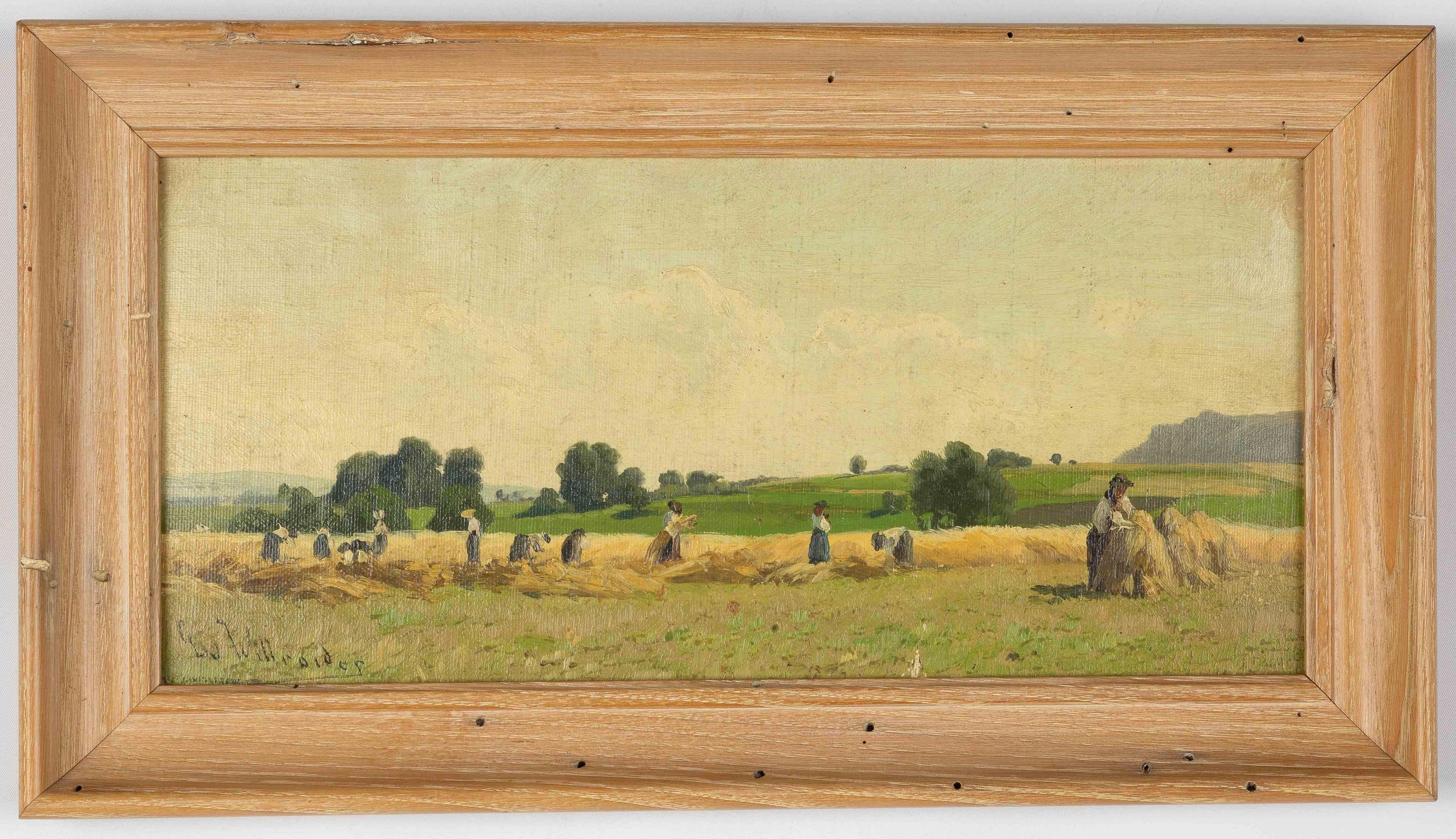
Harvest Scene
The painting is an intimate genre landscape depicting a harvest scene against the background of a vast rural landscape. The panoramic composition, typical of the artist's work, emphasizes the horizontal layout of the fields and the gently undulating terrain, stretching out under a bright, illuminated sky. In the foreground are visible figures of working reapers, shown with attention to detail and compositional rhythm, yet in full harmony with the landscape. The painting is characterized by Willroider's characteristic realism, combined with atmospheric mood and subtle chiaroscuro. The artist utilized a balanced color palette based on delicate greens, muted yellows, and blues, conveying the atmosphere of a quiet summer afternoon. Ludwig Willroider was a representative of the Munich School, a valued landscape painter, also associated with the artistic community of Vienna. In his work, he often explored Alpine landscapes and rural genre scenes, depicted in a realistic, yet picturesque manner.
Biography
Ludwig Willroider (Villach 1845 - Bernried 1910) – renowned German landscape painter and printmaker; brother, and initially also student, of the painter Josef Willroider. He later studied in Munich under the supervision of eminent artists of the Munich Landscape School – Adolf H. Lier, Eduard Schleich, and Karl Ebert. Willroider created both large-scale so-called "heroic" landscapes (Dies irae, Flood), as well as atmospheric landscapes of an intimate nature. The artist's paintings are in the collections of numerous German, European, and American museums, as well as in the collections of the National Museum in Warsaw and Wrocław.